
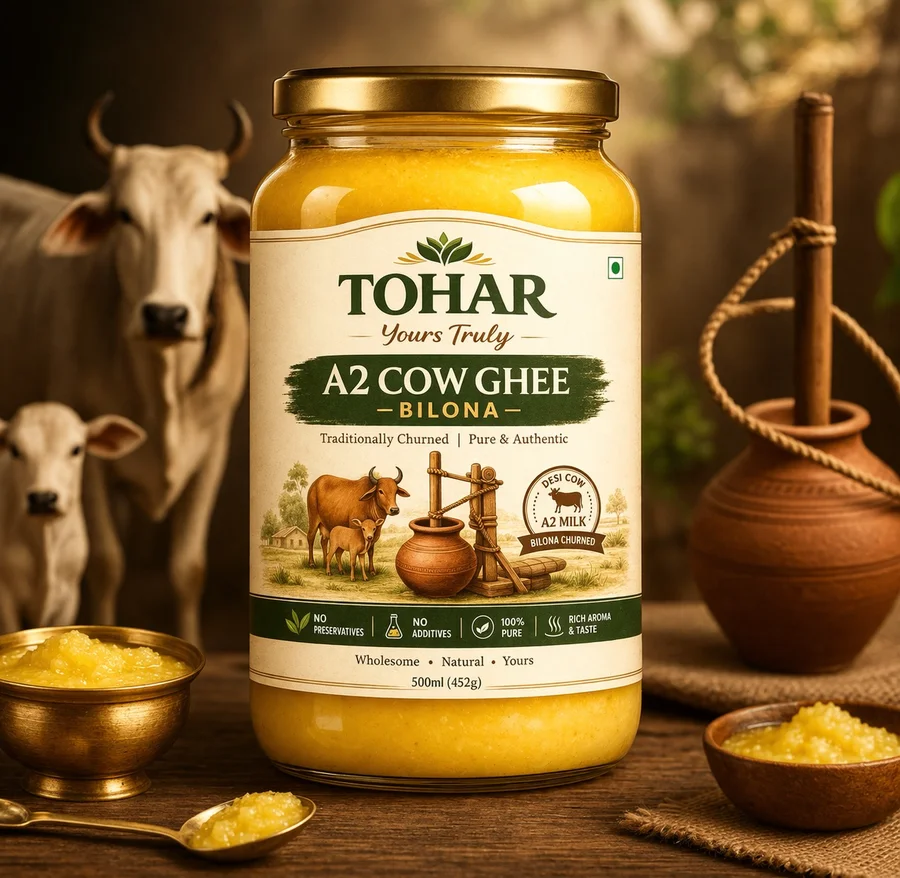
A2 Cow Ghee (Bilona)
Hand-churned the traditional way — curd churned with a wooden bilona, then slow-cooked into rich, aromatic A2 ghee.

Hand-churned the traditional way — curd churned with a wooden bilona, then slow-cooked into rich, aromatic A2 ghee.
Thousands of years old, unchanged.
"Bilona" comes from the Sanskrit for "to churn." It's a method that predates modern dairies by thousands of years — fresh milk is set into curd, then hand-churned with a wooden bilona (mathani) until white butter separates, before being slow-cooked into ghee over a gentle flame.
In Ayurveda, ghee made this way — starting from curd, not cream — is regarded as "amrit," a nectar valued for both food and medicine.
It's slower and more labour-intensive than modern cream-based methods, which is exactly why most commercial ghee has moved away from it. We haven't.
General footage of the traditional Bilona hand-churning process — not Tohar's own kitchen, but the same method.
Typical values for pure cow ghee, per 100g — general reference figures for this food category, not a lab-tested analysis of this specific batch. Get in touch if you'd like more detail.
| Nutrient | Typical Amount |
|---|---|
| Energy | ~870 kcal |
| Fat | ~99.5 g |
| Saturated Fat | ~61.9 g |
| Carbohydrates | 0 g |
| Protein | ~0.3 g |
| Cholesterol | ~256 mg |
What the process preserves.
Bilona-churned ghee retains more conjugated linoleic acid (CLA), studied for its role in fat metabolism.
A natural source of vitamins A, D, E and K — the vitamins your body absorbs best alongside healthy fat.
Contains butyric acid, studied for supporting the gut lining and a healthy digestive tract.
The clarification process removes roughly 95% of lactose, though trace casein may remain — caution advised for severe dairy allergies.
Stable at high cooking temperatures, so it doesn't break down the way many oils do when heated.
Unlike hydrogenated vegetable fats, traditionally made ghee contains no trans fats.
General wellness information based on published research on ghee — not medical advice. Speak with a healthcare professional for guidance specific to you.
Three everyday staples.